Jessica couldn’t pinpoint when everything started falling apart.
Six months ago, she and Mark were inseparable. Laughing at inside jokes. Planning their future. Finishing each other’s sentences. The kind of connection that made her friends jealous and her family relieved she’d finally found “the one.”
Now they barely spoke beyond logistics. “What time will you be home?” “Did you pay the electric bill?” “Your mom called again.” Conversations that were once effortless felt like pulling teeth. The warmth had been replaced by cold distance. The passion replaced by resentment.
What happened?
When Jessica thought back, there was no single catastrophic event. No cheating. No dramatic fight. No obvious betrayal. Just a slow, almost invisible erosion of what they once had.
The relationship didn’t explode… it suffocated.
The Silent Killers
Here’s what most women don’t understand about relationships: The behaviors that destroy them are rarely the dramatic, obvious ones. It’s not usually infidelity or abuse that ends good relationships.
It’s the small, seemingly harmless behaviors that compound over time. Behaviors that feel justified in the moment. Behaviors you don’t even realize are toxic until the damage is done. Behaviors that slowly poison the connection until nothing is left.
These behaviors are insidious because:
They start small and seem insignificant. You don’t notice them killing your relationship until it’s already dying or dead.
They feel normal or justified. In the moment, they seem like reasonable responses to legitimate frustrations.
They’re hard to recognize in yourself. It’s easy to see them in your partner, but blind to them in your own behavior.
They accumulate silently. Each instance is minor, but together they create a toxic environment that strangles intimacy.
Why This Matters More Than Ever
Modern relationships are more fragile than ever.
With dating apps creating the illusion that better options are always available, people walk away from relationships at the first sign of difficulty. There’s less tolerance for imperfection and less willingness to work through challenges.
Understanding the behaviors that kill relationships is critical because:
Prevention is easier than repair. Stopping these behaviors before they become patterns is far easier than trying to resurrect a dying relationship.
Most relationship problems are behavioral, not fundamental. You don’t need couples therapy if you stop doing the things that destroy connection.
These patterns repeat. If you don’t identify and change these behaviors, you’ll bring them into every relationship and wonder why nothing works.
Your partner can’t fix what you won’t acknowledge. Many women unknowingly engage in relationship-killing behaviors, then blame their partner for the deterioration.
The Cost of Ignorance
I’ve watched countless good relationships die because one or both partners engaged in behaviors that slowly killed the connection.
The tragedy? Most of these relationships could have been saved if the destructive behaviors had been recognized and stopped early.
Instead, couples drift apart. Connection fades. Resentment builds. And by the time they realize something is seriously wrong, the damage is often irreparable.
The Promise of This Article
I’m going to show you the seven most common behaviors that kill relationships… from a man’s perspective who has both witnessed these patterns countless times and, I’ll admit, engaged in some of them myself.
These aren’t theoretical concepts. They’re real, specific behaviors that destroy real relationships every single day.
You’ll discover:
- The exact behaviors that erode connection and create distance
- Why these behaviors are so destructive (the psychology behind them)
- How to recognize them in yourself before they destroy your relationship
- What to do instead… practical alternatives that strengthen rather than weaken bonds
- How to repair damage if you’ve already been engaging in these patterns
- Real examples of how these behaviors play out
- The early warning signs that these patterns are taking root
This isn’t about blame or shame. We all engage in destructive behaviors sometimes. The goal is awareness and change.
This also isn’t one-sided. While this article focuses on behaviors that kill relationships generally, both men and women engage in these patterns. I’m writing from a man’s perspective to give you insight into how these behaviors affect your partner.
By the end of this article, you’ll be able to identify the relationship-killing behaviors in your own patterns and make different choices before they cost you something precious.
Let’s dive in.
Table of Contents
- Behavior #1: Constant Criticism and Contempt
- Behavior #2: Keeping Score and Weaponizing the Past
- Behavior #3: Emotional Withdrawal as Punishment
- Behavior #4: Making Him Responsible for Your Happiness
- Behavior #5: Controlling and Micromanaging
- Behavior #6: Comparison and Competition
- Behavior #7: Refusing Vulnerability and Emotional Intimacy
- The Common Thread: Why These Behaviors Are So Destructive
- How to Stop These Patterns Before They Kill Your Relationship
- Conclusion: Choose Connection Over Being Right
<a name=”criticism-contempt”></a>
Behavior #1: Constant Criticism and Contempt
Insert image: Woman making disapproving face at partner
The Most Toxic Pattern
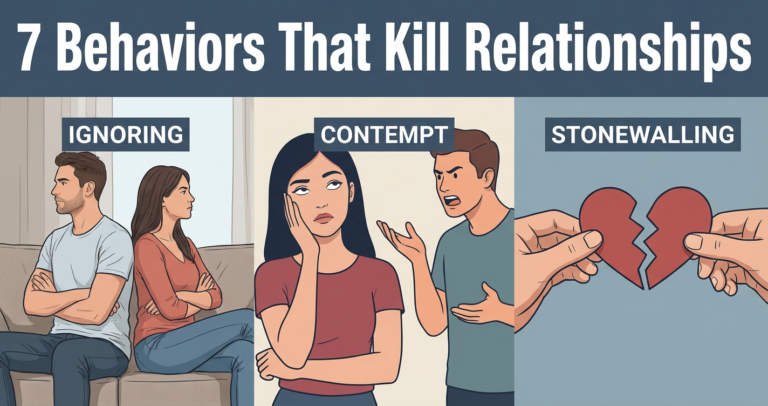
According to Dr. John Gottman’s four decades of relationship research, criticism and contempt are two of the “Four Horsemen of the Apocalypse”… predictors of relationship failure with over 90% accuracy.
Criticism attacks your partner’s character rather than addressing specific behaviors. It’s the difference between “You forgot to take out the trash” and “You’re so lazy and irresponsible.”
Contempt goes even further… it’s criticism laced with disgust, mockery, or superiority. Eye-rolling, sarcasm, name-calling, hostile humor, and condescension all signal contempt.
Of all the behaviors that kill relationships, contempt is the most lethal.
How This Destroys Connection
Every human being needs to feel respected by their partner. Criticism and contempt systematically destroy that respect, replacing it with:
Defensiveness:
- He stops being open
- Shuts down emotionally
- Builds walls to protect himself
- Connection becomes impossible
Resentment:
- Each criticism accumulates
- Bitterness builds over time
- Affection turns to hostility
- Love erodes into animosity
Withdrawal:
- He stops trying
- Distances himself emotionally
- Eventually stops caring
- Gives up on the relationship
Loss of psychological safety:
- Can’t be himself around you
- Walks on eggshells
- Fears your reactions
- Relationship becomes stressful, not safe
Rachel’s Wake-Up Call
Rachel didn’t think she was being contemptuous. She was just being “honest” about Marcus’s flaws:
“You’re being ridiculous.” “That’s the stupidest thing I’ve ever heard.” “Why are you always so sensitive?” “Seriously? You can’t even do this one simple thing?”
Eye rolls when he shared opinions. Sighs of exasperation when he spoke. Dismissive laughter at his ideas. Sarcastic comments disguised as jokes.
To Rachel, this was normal communication. To Marcus, it was death by a thousand cuts.
After two years, Marcus told her he wanted out.
“I can’t do this anymore,” he said. “I feel like nothing I do is good enough. You criticize everything. You treat me with contempt. I don’t feel loved… I feel tolerated at best, despised at worst.”
Rachel was shocked. She didn’t see herself as contemptuous. But Marcus had been dying inside for months from her constant criticism and disdain.
The Psychology Behind It
Why do people fall into criticism and contempt patterns?
Perfectionism and unrealistic standards:
- You expect him to meet impossible standards
- When he falls short, you criticize
- Nothing he does is ever quite right
- Your standards are the problem, not his behavior
Unresolved resentment:
- You’re angry about something deeper
- Criticism is how the anger leaks out
- The real issue never gets addressed
- Surface criticisms mask core problems
Learned patterns from childhood:
- Critical parents modeled this behavior
- You learned this is how people relate
- Doesn’t make it healthy
- Requires conscious unlearning
Anxiety and need for control:
- Criticism is an attempt to change him
- Making him “better” reduces your anxiety
- But it destroys connection in the process
- Control attempts always backfire
What to Do Instead
Turn complaints into requests:
| Criticism | Request |
|---|---|
| “You never help around the house!” | “Would you mind doing the dishes tonight?” |
| “You’re so lazy!” | “I’d really appreciate help with the laundry.” |
| “You don’t care about me!” | “I need more quality time together. Can we plan a date night?” |
| “You’re always late!” | “It’s important to me that we’re on time. Can you set a reminder?” |
Express needs without attacking character:
- Focus on specific behaviors, not personality
- Use “I feel” instead of “You are”
- Request specific changes
- Appreciate effort
Eliminate contempt completely:
- No eye-rolling
- No sarcasm at his expense
- No mockery or name-calling
- No hostile “jokes”
- Treat him with respect always
Build a culture of appreciation:
- Notice what he does right
- Express genuine appreciation
- Focus on positives
- Create 5:1 ratio of positive to negative interactions
“In a good relationship, people get angry, but in a very different way. The Marriage Masters see a problem a bit like a soccer ball. They kick it around. It’s ‘our’ problem.” … Dr. John Gottman
<a name=”keeping-score”></a>
Behavior #2: Keeping Score and Weaponizing the Past
The Resentment Bank
One of the most insidious behaviors that kill relationships: keeping a mental scorecard of every mistake, disappointment, or failure.
You remember the time he forgot your birthday three years ago. The fight you had on vacation. The promise he broke. The insensitive comment he made. Every transgression filed away, ready to be weaponized in future arguments.
This isn’t memory… it’s ammunition.
How Scorekeeping Destroys Relationships
It prevents healing:
- Issues are never truly resolved
- They’re just filed away for later
- Nothing can be forgiven
- The past never stays in the past
It creates constant resentment:
- You’re living in past hurts
- Can’t be present with who he is now
- Every current issue triggers old wounds
- Resentment compounds over time
It makes him feel hopeless:
- No matter what he does now
- Past mistakes always thrown in his face
- Can never be forgiven
- Why bother trying to change?
It prevents growth:
- People can’t evolve
- Stuck in old patterns
- No room for learning from mistakes
- Past defines forever
David’s Experience
David made a mistake four years into his relationship with Amanda. During a difficult period, he’d been dismissive of her feelings about a major decision.
He apologized. They worked through it. He changed his behavior. Or so he thought.
For the next three years, Amanda brought it up in every argument:
“Remember when you completely ignored my feelings about the house?”
“This is just like when you didn’t care about what I wanted.”
“You always do this… just like that time you…”
No matter what the current issue was, Amanda weaponized the past. David couldn’t escape something he’d done years ago, already apologized for, and actively changed.
“I felt like I could never be forgiven,” David said. “I was trapped by a version of myself that didn’t exist anymore. Eventually, I gave up trying to be better because it didn’t matter… she’d never let me forget who I used to be.”
The Psychology of Scorekeeping
Why do people keep score?
Unresolved hurt:
- The original issue was never truly worked through
- Apology wasn’t enough
- Healing didn’t happen
- Wound stayed open
Protection mechanism:
- If you remember every hurt
- You can protect against future ones
- Past becomes armor
- But armor also isolates
Power and control:
- Past mistakes give leverage
- Can be used to win arguments
- Make him feel guilty
- Control through shame
Anxious attachment patterns:
- Fear of being hurt again
- Hypervigilance to potential threats
- Can’t fully trust
- Past evidence of unworthiness
Breaking the Scorekeeping Pattern
Decide: Forgive or leave
If you’re staying in the relationship, truly forgive past issues. If you can’t forgive, you shouldn’t stay. Staying but holding onto resentment poisons everything.
Create closure for past issues:
When something is resolved:
- Have a specific conversation closing it
- “We’ve worked through this. I’m choosing to forgive and move forward.”
- Commit to not bringing it up again
- If it resurfaces, that means it wasn’t actually resolved
Deal with current issues on their own merit:
- Address what’s happening now
- Don’t reference past patterns
- Each issue deserves fresh evaluation
- “This situation reminds me of…” is scorekeeping
Acknowledge growth and change:
- Notice when he’s different
- Recognize efforts to change
- Don’t trap him in past versions
- Allow evolution
Build new positive memories:
- Create experiences that overshadow the past
- Focus on who you both are now
- Build a bank of positive interactions
- Let good memories outweigh bad ones
When It’s Legitimate to Reference the Past
There’s a difference between weaponizing the past and recognizing patterns:
Weaponizing:
- “You forgot my birthday five years ago!”
- Using past to shame
- Bringing up resolved issues
- Keeping score to win arguments
Pattern recognition:
- “I notice this is the third time this month you’ve cancelled plans at the last minute. Can we talk about why that’s happening?”
- Identifying current patterns
- Addressing ongoing behavior
- Solution-focused
The difference: Pattern recognition addresses current repeated behavior to solve it. Weaponizing brings up old, resolved issues to shame or control.
<a name=”emotional-withdrawal”></a>
Behavior #3: Emotional Withdrawal as Punishment
Insert image: Woman turning away from partner in bed
The Silent Treatment
Few things feel worse to a man than being frozen out by the woman he loves.
Emotional withdrawal… the silent treatment, coldness, refusing to engage, icing him out… is one of the most damaging behaviors that kill relationships because it weaponizes the connection itself.
You’re essentially saying: “I will remove my love, affection, and presence from you until you do what I want.”
How This Destroys Intimacy
It creates insecurity:
- He never knows when you’ll withdraw
- Can’t relax into the relationship
- Walks on eggshells
- Attachment becomes anxious
It’s emotional manipulation:
- Using connection as bargaining chip
- Punishment instead of communication
- Control through withholding
- Coercion disguised as boundaries
It prevents resolution:
- Can’t solve problems if you won’t talk
- Issues fester and grow
- Resentment builds on both sides
- Disconnection becomes the norm
It damages trust:
- Your love feels conditional
- Connection isn’t safe
- He can’t count on you
- Emotional foundation crumbles
Lisa’s Pattern
Whenever Tom did something that upset Lisa, she’d shut down completely.
No conversation. No explanation. Just cold silence.
Tom would come home to a wife who wouldn’t look at him, wouldn’t speak to him, wouldn’t acknowledge his presence. Sometimes for hours. Sometimes for days.
“I felt like I was being erased,” Tom said. “Like I didn’t exist. The woman who claimed to love me would completely cut me off emotionally. It was torture.”
Lisa thought she was protecting herself. When she was hurt or angry, she withdrew to avoid saying something she’d regret.
But what she was actually doing was punishing Tom and preventing any real resolution.
After five years, Tom left. “I couldn’t live with someone who would turn me into a ghost whenever she was upset. I needed a partner who could communicate, not someone who weaponized silence.”
The Psychology of Withdrawal
Why do people withdraw emotionally?
Conflict avoidance:
- Fear of confrontation
- Uncomfortable with anger
- Withdrawal feels safer
- But creates bigger problems
Learned behavior:
- Parents modeled this pattern
- How conflict was “handled” in childhood
- Repeating dysfunctional patterns
- Needs conscious change
Punishment and control:
- Making him suffer for his transgression
- Forcing him to pursue and placate
- Power through withholding
- Manipulation masked as self-protection
Emotional overwhelm:
- Too activated to communicate
- Need space to regulate
- Can’t access words
- Physiological shutdown
The Difference Between Withdrawal and Healthy Space
There’s a critical difference:
Emotional withdrawal (toxic):
- “I’m shutting you out until you apologize/change/do what I want”
- Punishment disguised as self-care
- No communication about what you’re doing
- Indefinite timeline
- Refusal to engage
Healthy space (constructive):
- “I’m too upset to have this conversation productively right now. I need an hour to calm down, then let’s talk.”
- Self-regulation, not punishment
- Clear communication
- Specific timeline
- Commitment to return and engage
What to Do Instead
Communicate your need for space:
Instead of: Silent treatment
Try: “I’m really upset right now and I need 30 minutes to calm down before we talk about this. Let’s reconnect at 7pm.”
Express your feelings directly:
- Use words instead of withdrawal
- “I’m hurt because…”
- “I’m angry that…”
- “I need…”
Set boundaries without punishment:
- “I need some time alone” is a boundary
- Silent treatment is punishment
- Communicate the boundary
- Don’t weaponize distance
Return and engage:
- If you need space, take it
- But come back to resolve
- Don’t leave issues hanging
- Closure requires conversation
Develop emotional regulation skills:
- Learn to tolerate discomfort
- Practice staying present when upset
- Build capacity for difficult conversations
- Work with a therapist if needed
“Silence is not a response. Silence is a manipulation tactic that is effective for shutting down communication.” … Unknown
<a name=”responsible-happiness”></a>
Behavior #4: Making Him Responsible for Your Happiness
The Impossible Burden
One of the most relationship-killing behaviors women engage in: Making their partner responsible for their emotional well-being, happiness, and sense of fulfillment.
When your happiness depends entirely on him:
- What he does or doesn’t do
- How much attention he gives you
- Whether he meets your needs perfectly
- His mood and emotional state
You’ve created an impossible situation where he can never do enough, you’re perpetually disappointed, and the relationship suffocates under the weight of your expectations.
How This Destroys Relationships
It creates unbearable pressure:
- He’s responsible for your entire emotional state
- One wrong move and you fall apart
- Can never relax or be himself
- Constant vigilance required
It leads to resentment on both sides:
- You resent him for not making you happy enough
- He resents you for making him responsible
- Neither can win
- Bitterness grows
It prevents authentic intimacy:
- He can’t be real with you
- Must manage your emotions constantly
- Can’t have his own feelings
- Connection becomes performance
It makes you unattractive:
- Neediness repels
- Independence attracts
- Desperation for happiness from him kills desire
- He becomes obligation, not choice
Monica’s Trap
Monica’s entire emotional state depended on Jake.
If Jake was affectionate and attentive: Monica was happy, bubbly, content.
If Jake was stressed, distracted, or needed space: Monica spiraled into anxiety, depression, and accusations that he didn’t love her.
“I felt like I was carrying two people’s emotional weight,” Jake explained. “I couldn’t have a bad day without her falling apart. I couldn’t need alone time without her feeling abandoned. I couldn’t be human… I had to be her emotional support system 24/7.”
Monica’s happiness was entirely external. She had no internal resources, no independent sources of joy, no emotional regulation skills.
After three years, Jake was exhausted. “I loved her, but I couldn’t be responsible for her entire emotional existence. It was drowning me.”
The Psychology Behind It
Why do women make partners responsible for their happiness?
Anxious attachment:
- Need constant reassurance
- External validation required
- Can’t self-soothe
- Partner becomes emotional regulator
Lack of independent identity:
- Life revolves around relationship
- No hobbies, friends, or interests outside him
- Identity is “his girlfriend/wife”
- Emptiness without him
Unmet childhood needs:
- Looking to partner to fill parental gaps
- Expecting him to heal old wounds
- Unconscious reenactment
- Needs therapy, not relationship
Cultural conditioning:
- “You complete me” mythology
- Believing partner should make you whole
- Romantic movies and songs reinforce this
- But it’s toxic in reality
What Emotional Responsibility Looks Like
Making him responsible (unhealthy):
- “You make me so happy!”
- “I can’t be happy without you.”
- “If you loved me, you’d…”
- “You’re responsible for how I feel.”
- Your mood entirely depends on his behavior
Taking responsibility (healthy):
- “I’m happy, and sharing this with you makes it even better.”
- “I’m responsible for my own happiness, and I choose to build a life with you.”
- “I feel hurt when you do X. I need Y.”
- “I’m working on managing my emotions.”
- Your mood is your responsibility; you communicate needs clearly
Building Emotional Independence
Create your own sources of happiness:
Strong friendships:
- Deep connections outside the relationship
- People who fill different needs
- Social support system
Meaningful work or purpose:
- Career fulfillment
- Volunteer work
- Creative projects
- Something that matters to you
Hobbies and interests:
- Activities you’re passionate about
- Things you do for yourself
- Sources of joy independent of him
- Your own life
Self-care practices:
- Exercise
- Meditation
- Therapy
- Journaling
- Whatever helps you stay regulated
Develop emotional regulation skills:
- Learn to manage your own feelings
- Self-soothe when upset
- Don’t immediately turn to him
- Build internal resources
Differentiate needs from wants:
- “I need him to be faithful” = reasonable need
- “I need him to text me every hour or I can’t function” = unhealthy dependence
- Know the difference
| Emotional Dependence | Emotional Independence |
|---|---|
| “You’re my everything” | “You’re incredibly important to me” |
| Mood controlled by his attention | Stable regardless of his mood |
| No life outside relationship | Rich, full life he enhances |
| Constant need for reassurance | Secure in yourself and relationship |
| Can’t be happy without him | Happy with yourself, happier with him |
The truth: The happiest relationships involve two people who don’t need each other but choose each other. When you’re whole on your own, the relationship is enhancement, not completion.
<a name=”controlling”></a>
Behavior #5: Controlling and Micromanaging
Insert image: Woman directing/instructing partner with frustrated expression
The Mother-Boyfriend Dynamic
Nothing kills romantic attraction faster than turning into his mother.
When you try to control, manage, direct, and micromanage his life, choices, behaviors, and decisions, you transform from partner to parent… and the relationship dies.
Controlling behaviors include:
- Telling him how to dress
- Managing his time and schedule
- Dictating his friendships
- Controlling his finances
- Criticizing his choices constantly
- “Helping” him be better (without him asking)
- Making decisions for him
- Treating him like he’s incompetent
Why This Is Relationship Poison
It destroys respect:
- You don’t respect his autonomy
- He loses respect for himself
- Mutual respect disappears
- Foundation crumbles
It kills attraction:
- Mothers aren’t sexy
- Control isn’t attractive
- Dominance creates resentment, not desire
- Sexual chemistry dies
It creates rebellion:
- He starts doing things just to assert independence
- Sneaking around like a teenager
- Lying to avoid your controlling reactions
- Fighting for basic autonomy
It prevents partnership:
- You’re not equals
- You’re boss and subordinate
- Or parent and child
- Not adult partnership
Sarah’s Controlling Pattern
Sarah loved Kevin… she just thought she could help him be better.
She critiqued his wardrobe: “You can’t wear that. Here, I picked out something better.”
She managed his social life: “You’re not hanging out with those friends. They’re a bad influence.”
She directed his career: “You should take that job. I know what’s best for your career.”
She controlled his free time: “Why do you need to play video games? That’s such a waste of time.”
Sarah thought she was being helpful. She was just trying to make Kevin the best version of himself.
But Kevin felt suffocated. “I felt like I couldn’t make any decision without her approval. She treated me like I was incapable of managing my own life. I wasn’t her partner… I was her project.”
The relationship ended after two years. Kevin’s final words: “I need to be with someone who respects me as an adult, not someone who treats me like a child who needs constant correction.”
The Psychology of Control
Why do women become controlling?
Anxiety:
- Controlling external factors reduces anxiety
- If you can manage everything, nothing can go wrong
- But it’s an illusion
- And it destroys relationships
Perfectionism:
- You have a vision of how things should be
- His way doesn’t match your vision
- Must correct and control
- Your way is the “right” way
Trust issues:
- Don’t trust him to make good decisions
- Fear he’ll mess up
- Must supervise everything
- Lack of basic faith in him
Learned patterns:
- Controlling parent modeled this
- It’s how you learned to relate
- Feels normal even though it’s toxic
- Requires conscious change
Genuine concern taken too far:
- You love him and want the best for him
- But helping crosses into controlling
- Good intentions, destructive execution
- Boundary confusion
The Difference Between Influence and Control
Healthy influence:
- “I noticed you’ve been stressed. Have you considered talking to someone about it?”
- Suggestion, not demand
- Respects his autonomy
- He chooses
Control:
- “You need to see a therapist. I already made you an appointment.”
- Directive, not suggestion
- Doesn’t respect his autonomy
- You choose for him
Healthy influence:
- “I really love when you wear that blue shirt. It looks great on you.”
- Expresses preference
- Leaves choice to him
- Positive reinforcement
Control:
- “You’re not wearing that. Go change.”
- Demands compliance
- Removes his choice
- Treats him like a child
What to Do Instead
Respect his autonomy:
- He’s an adult capable of making decisions
- Even if you disagree with them
- Even if you think you know better
- His life, his choices
Offer input only when asked:
- Wait for “What do you think?”
- Don’t volunteer unsolicited advice
- Respect that he didn’t ask for your opinion
- Let him lead his own life
Trust him:
- Believe he can handle his own life
- Give him space to make mistakes
- Don’t rescue or fix constantly
- Trust builds respect
Focus on your own life:
- Channel controlling energy into your own goals
- Manage yourself, not him
- Let him manage himself
- Build your own fulfilling life
Set boundaries instead of controlling:
- “I’m not comfortable with X in our relationship” = boundary
- “You can’t do X” = control
- Boundaries are about you
- Control is about him
Choose a partner you don’t need to change:
- If you’re constantly trying to fix or improve him
- He’s not the right person
- Accept him as he is or leave
- Don’t stay and try to transform him
<a name=”comparison”></a>
Behavior #6: Comparison and Competition
The Comparison Trap
One of the most insidious behaviors that kill relationships: constantly comparing your partner to others… or competing with him instead of being his teammate.
Comparison shows up as:
- “Why can’t you be more like [friend’s husband]?”
- “My ex used to…”
- “Other men do X for their girlfriends.”
- Social media comparison to other couples
- Measuring him against impossible standards
Competition shows up as:
- One-upping his stories
- Making everything about who’s busier/more stressed/more important
- Competing for victim status
- Turning partnership into rivalry
How This Destroys Connection
It makes him feel inadequate:
- He’ll never measure up
- Always falling short
- Constant failure in your eyes
- Why bother trying?
It breeds resentment:
- Toward you for comparing
- Toward the people you compare him to
- Toward himself for not being enough
- Poisons the entire relationship
It prevents appreciation:
- Can’t see what he does right
- Only notice what he doesn’t do
- Blind to his unique strengths
- Gratitude disappears
It kills teamwork:
- You’re opponents, not partners
- Everything is competition
- Can’t celebrate each other
- Working against instead of with
Emma’s Damaging Pattern
Emma didn’t mean to be hurtful… she just wanted Nathan to step up.
So she compared:
“Sarah’s husband planned this amazing surprise trip for their anniversary. Why don’t you ever do stuff like that?”
“My ex was so romantic. He always bought me flowers.”
“Look at this couple on Instagram. See how he supports her career?”
Each comparison was a small wound. And Nathan accumulated hundreds of them over three years.
“I never felt like I was enough,” Nathan said. “No matter what I did, there was always someone doing it better according to Emma. I wasn’t competing with real people… I was competing with her idealized fantasy of what a man should be. I could never win.”
Nathan stopped trying. What’s the point when you’re always going to fall short?
The Psychology of Comparison
Why do people compare?
Unmet expectations:
- You have a vision of what relationship should be
- He doesn’t match it
- Comparison is frustration leaking out
- Expectations are the problem
Social media influence:
- Constantly seeing curated, perfect relationships
- Forgetting they’re highlight reels
- Comparing your behind-the-scenes to others’ highlight reels
- Recipe for dissatisfaction
Manipulation tactic:
- Trying to shame him into changing
- Using others as examples of “right way”
- Attempting to motivate through inadequacy
- Always backfires
Insecurity:
- Worried you’re missing out
- Fear others have better relationships
- Grass-is-greener thinking
- Inability to appreciate what you have
The Competition Dynamic
Some women turn relationships into competitions:
Everything becomes a contest:
- Who’s more tired
- Who’s more stressed
- Who works harder
- Who sacrifices more
You minimize his experiences:
- “You think you’re tired? I only got 4 hours of sleep.”
- “That’s nothing compared to what I’m dealing with.”
- “At least you get to…”
- Invalidating his feelings
You can’t celebrate his wins:
- He gets a promotion, you feel threatened
- He succeeds, you minimize it
- Can’t be genuinely happy for him
- His win feels like your loss
What to Do Instead
Practice gratitude:
- Focus on what he does well
- Notice his unique strengths
- Appreciate his specific ways of loving
- Express genuine thanks
Stop consuming comparison fuel:
- Limit social media
- Stop comparing your relationship to others’
- Remember you’re seeing curated versions
- Focus on your own relationship
Communicate needs directly:
Instead of: “Why can’t you be romantic like Sarah’s husband?”
Try: “I would really love it if we could plan a special date night once a month. Would you be willing to plan the next one?”
Be his teammate, not his competitor:
- Celebrate his successes genuinely
- Support his goals
- You win together or lose together
- Partnership, not rivalry
Acknowledge his way of loving:
- He might not show love the way you want
- But notice how he does show it
- Different doesn’t mean wrong
- Appreciate his unique expressions
Set realistic expectations:
- He’s human, not perfect
- Has strengths and weaknesses
- Can’t be everything
- Accept the full person
| Comparison/Competition | Partnership |
|---|---|
| “Why can’t you be more like him?” | “I appreciate how you…” |
| “My ex used to…” | “I love when you…” |
| “You think you’re stressed?” | “That sounds really difficult” |
| Measuring against others | Appreciating who he is |
| His success threatens you | His success is your success |
“Comparison is the thief of joy.” … Theodore Roosevelt
The truth: When you’re constantly comparing your partner to others or competing with him, you’re telling him he’s not enough. And eventually, he’ll believe you and either stop trying or leave.
<a name=”refusing-vulnerability”></a>
Behavior #7: Refusing Vulnerability and Emotional Intimacy
Insert image: Woman with arms crossed, looking away defensively
The Walls That Isolate
The final behavior that kills relationships… and perhaps the most overlooked: Building walls and refusing to be emotionally vulnerable with your partner.
This shows up as:
- Never sharing your real feelings
- Deflecting with humor when things get deep
- Keeping him at arm’s length emotionally
- Refusing to admit when you’re hurt or scared
- Maintaining emotional independence to a fault
- Not letting him see the real you
- Protecting yourself by never being truly known
Why This Kills Intimacy
Connection requires vulnerability:
- Intimacy means “into me see”
- Can’t connect if he can’t see you
- Walls protect but also isolate
- No vulnerability = no depth
It prevents him from loving the real you:
- He only sees the mask
- Doesn’t know your heart
- Can’t love who he doesn’t know
- Relationship stays superficial
It creates one-sided vulnerability:
- If he opens up but you don’t
- He feels exposed and unsafe
- Eventually he’ll close off too
- Connection dies
It signals you don’t trust him:
- Withholding vulnerability says “I don’t trust you”
- Kills his desire to be vulnerable
- Creates distance and disconnection
- Relationship can’t deepen
Julia’s Fortress
Julia prided herself on being strong and independent. She’d been hurt before and swore she’d never be that vulnerable again.
So with Michael, she kept walls up:
When she was sad, she said she was fine. When she was scared, she hid it. When she needed comfort, she pretended she didn’t. When Michael tried to go deeper, she deflected with jokes.
Michael tried for two years to really know her, to connect with her on a deeper level, to be let into her inner world.
“It felt like loving a ghost,” Michael said. “I knew surface Julia… fun, successful, put-together. But I never knew real Julia. She wouldn’t let me in. I wanted to be her partner, but she wouldn’t let me be there for her when she was struggling. It felt like she didn’t actually need me or trust me.”
Eventually, Michael left. Not because he didn’t love her… but because he couldn’t have a real relationship with someone who refused to be real with him.
The Psychology of Emotional Unavailability
Why do women refuse vulnerability?
Past hurt:
- Been betrayed or wounded before
- Vulnerability led to pain
- Walls are protection
- But they also prevent connection
Fear of rejection:
- If he sees the real you, he might leave
- Better to keep mask on
- But then he’s not actually with you
- Paradox of self-protection
Avoidant attachment:
- Uncomfortable with closeness
- Independence valued over connection
- Vulnerability feels dangerous
- Distance feels safe
Cultural messages:
- “Don’t need anyone”
- “Strong women don’t show weakness”
- Independence glorified
- Vulnerability seen as weakness
Shame:
- Parts of yourself you judge
- Feelings you think are unacceptable
- Fear of being seen as “too much”
- Hiding to avoid judgment
The Difference Between Healthy Boundaries and Walls
Healthy boundaries:
- “I need time to process this before sharing”
- Pacing vulnerability appropriately
- Protecting yourself while still being open
- Gradual deepening
Walls:
- “I’m fine” when you’re clearly not
- Never sharing real feelings
- Deflecting all attempts at depth
- Permanent protection that prevents connection
Healthy independence:
- Having your own life and identity
- Not being needy or clingy
- Self-sufficiency in practical matters
- While still being emotionally open
Emotional unavailability:
- Using independence to avoid intimacy
- Never needing emotional support
- Refusing to lean on him ever
- Independence as armor
Breaking Down the Walls
Start small:
- Share smaller vulnerabilities first
- Build safety gradually
- Notice he doesn’t use it against you
- Increase vulnerability over time
Name your feelings:
- Practice saying “I feel…”
- Even when uncomfortable
- Even when scared
- Especially when it matters
Let him comfort you:
- When you’re upset, don’t hide it
- Allow him to be there for you
- Accept his support
- Let him see you need him sometimes
Share your fears and insecurities:
- The things you usually hide
- What you’re afraid of
- What you’re insecure about
- Your authentic inner experience
Stop deflecting with humor:
- When conversation gets deep, stay there
- Don’t joke your way out
- Sit in the discomfort
- Allow real connection
Admit when you’re wrong:
- Drop the defensiveness
- Own your mistakes
- Apologize genuinely
- Show you’re human
Ask for what you need:
- “I need comfort right now”
- “I’m scared and need reassurance”
- “I’m struggling and need support”
- Letting him matter to you
The Paradox of Vulnerability
Here’s what most women don’t understand: You think vulnerability makes you weak and will push him away.
The truth is the opposite.
Appropriate vulnerability with the right person:
- Creates deeper connection
- Builds intimacy
- Makes him feel needed and valued
- Allows him to love the real you
- Strengthens the bond
The key is appropriate vulnerability:
- Not trauma-dumping on the first date
- Not using vulnerability to manipulate
- Not being needy and desperate
- But genuinely sharing your authentic self with someone who’s earned that trust
Men want to be with real women, not perfect ones. They want to know you, see you, understand you. They want to matter to you and be needed sometimes.
When you refuse all vulnerability, you’re essentially saying: “I don’t need you. You don’t matter. I won’t let you in.”
And eventually, he’ll stop trying to get in.
<a name=”common-thread”></a>
The Common Thread: Why These Behaviors Are So Destructive
What Links Them All
All seven of these behaviors that kill relationships share common elements:
They prioritize control over connection:
- Trying to manage, fix, or change him
- Protecting yourself
- Maintaining power
- At the expense of intimacy
They create emotional distance:
- Push him away
- Build walls
- Prevent closeness
- Destroy vulnerability
They’re rooted in fear:
- Fear of being hurt
- Fear of not being enough
- Fear of vulnerability
- Fear of loss of control
They prevent partnership:
- Create parent-child dynamics
- Or competitor dynamics
- Or guard-prisoner dynamics
- Not adult partnership
They’re often unconscious:
- You don’t realize you’re doing them
- They feel normal or justified
- Learned patterns from past
- Require awareness to change
The Cycle They Create
These behaviors create a destructive cycle:
- You engage in the behavior (criticism, control, withdrawal, etc.)
- He feels hurt, controlled, or pushed away
- He withdraws or becomes defensive
- You feel rejected and do more of the behavior
- He withdraws further
- The relationship spirals into disconnection
Breaking the cycle requires:
- Recognizing your patterns
- Taking responsibility
- Making different choices
- Repairing damage done
<a name=”stop-patterns”></a>
How to Stop These Patterns Before They Kill Your Relationship
Insert image: Couple having calm, connected conversation
The Path to Change
If you’ve recognized yourself in these behaviors, don’t despair. Awareness is the first step to change. Here’s how to stop these patterns:
Step 1: Radical Self-Awareness
Start noticing your patterns:
- Keep a journal
- Notice when you engage in these behaviors
- What triggers them?
- What are you feeling beforehand?
- What need are you trying to meet?
Get feedback:
- Ask your partner (if the relationship is still intact)
- Ask trusted friends
- Consider therapy
- Be willing to hear hard truths
Step 2: Understand the Root Causes
Dig deeper into why:
- What fear drives this behavior?
- What need am I trying to meet?
- Where did I learn this pattern?
- What past wounds am I protecting?
Common root causes:
- Childhood experiences with caregivers
- Past relationship trauma
- Attachment wounds
- Unhealed pain
- Learned family patterns
Step 3: Develop Healthier Alternatives
For each destructive behavior, create a healthy alternative:
Instead of criticism → Express needs and appreciation
Instead of scorekeeping → Forgive or leave
Instead of withdrawal → Communicate need for space
Instead of making him responsible → Build your own happiness
Instead of controlling → Respect his autonomy
Instead of comparing → Practice gratitude
Instead of walls → Choose appropriate vulnerability
Step 4: Practice New Behaviors
Change requires consistent practice:
Pause before reacting:
- When triggered, take a breath
- Notice the urge to engage in old pattern
- Choose different response
- It gets easier with practice
Start small:
- Pick one behavior to change first
- Practice in low-stakes situations
- Build new neural pathways
- Add more as you succeed
Be patient with yourself:
- You’ll slip up
- Old patterns are strong
- Progress isn’t linear
- Keep trying
Step 5: Repair Damage Done
If you’ve been engaging in these behaviors:
Apologize genuinely:
- “I realize I’ve been [specific behavior]. I’m sorry. I’m working on changing this.”
- Take full responsibility
- Don’t make excuses
- Show you understand impact
Commit to change:
- “I’m committed to [specific new behavior] instead.”
- Ask for his support
- Be accountable
- Follow through
Rebuild trust:
- Consistency over time
- Actions matching words
- Demonstrating real change
- Patience with his healing
Step 6: Consider Professional Help
Some patterns require therapeutic support:
Consider therapy if:
- Patterns are deeply ingrained
- Rooted in trauma
- You can’t change on your own
- Relationship is in serious trouble
Therapy can help with:
- Understanding root causes
- Developing new patterns
- Healing past wounds
- Building healthier relationship skills
Step 7: Know When to Walk Away
Sometimes the healthiest choice is ending the relationship:
If you need to leave:
- You’re not capable of being healthy partner right now
- Need to work on yourself before being in relationship
- Pattern is too entrenched to change while together
- He’s also toxic and you enable each other
If he needs to leave:
- He’s unwilling to work on his part
- He’s abusive
- He doesn’t want to repair
- The relationship is too damaged
Walking away can be:
- Most loving choice
- Opportunity for both to heal
- Chance to start over healthier
- Better than staying in toxicity
<a name=”conclusion”></a>
Conclusion: Choose Connection Over Being Right
Insert image: Couple embracing, looking peaceful and connected
The Relationship You Choose
We’ve explored seven behaviors that kill relationships:
- Constant criticism and contempt – attacking character instead of addressing behavior
- Keeping score and weaponizing the past – never forgiving, always remembering
- Emotional withdrawal as punishment – using connection as a weapon
- Making him responsible for your happiness – looking outside for internal fulfillment
- Controlling and micromanaging – treating him like a child instead of a partner
- Comparison and competition – measuring him against others or fighting instead of partnering
- Refusing vulnerability and emotional intimacy – building walls that prevent real connection
These behaviors don’t destroy relationships overnight. They work slowly, quietly, invisibly… until one day you wake up next to a stranger, wondering what happened to the love you once had.
The Brutal Truth
Here’s what you need to understand: These behaviors feel justified in the moment. They feel like reasonable responses to legitimate frustrations. They feel normal, even necessary.
But they’re poison.
Every time you criticize instead of appreciate. Every time you withdraw instead of communicate. Every time you control instead of trust. Every time you compare instead of value. You’re choosing to kill your relationship by inches.
The question is: Are you willing to stop?
The Choice You Face
In every moment of frustration, hurt, or fear, you have a choice:
You can engage in the behaviors that feel familiar but destroy connection.
Or you can choose behaviors that feel vulnerable but create intimacy.
You can be right, or you can be connected. You can win the argument, or you can strengthen the relationship. You can protect yourself with walls, or you can build intimacy through vulnerability.
You rarely get both.
What Real Love Requires
Healthy, lasting relationships require:
Humility:
- Admitting when you’re wrong
- Recognizing your destructive patterns
- Being willing to change
- Putting relationship above ego
Vulnerability:
- Letting him see you
- Sharing your real feelings
- Risking hurt for connection
- Trusting him with your heart
Respect:
- For his autonomy
- For his choices
- For his humanity
- For his inherent worth
Grace:
- Forgiving past mistakes
- Allowing him to grow
- Not holding grudges
- Starting fresh repeatedly
Partnership:
- Being teammates, not competitors
- Supporting each other’s success
- Working together toward shared goals
- Celebrating each other’s wins
Consistency:
- Choosing connection daily
- Not just when it’s easy
- Through conflict and challenge
- Building trust over time
The Relationship You Deserve
You deserve a relationship where:
- You feel safe being yourself
- Mistakes are forgiven
- Growth is encouraged
- Connection deepens over time
- Both partners do the work
- Love feels nourishing, not draining
But here’s the hard truth: You can’t have that relationship if you’re engaging in behaviors that kill it.
You can’t receive vulnerability if you won’t give it. You can’t expect forgiveness if you keep score. You can’t demand respect while being contemptuous. You can’t want partnership while being controlling.
The relationship you want requires you to become the partner who creates it.
Starting Today
If you’ve recognized yourself in these patterns, here’s what to do starting right now:
Apologize to your partner if needed:
- Be specific about what you did
- Take full responsibility
- Commit to change
- Follow through
Choose one behavior to focus on changing:
- Don’t try to fix everything at once
- Pick the most destructive pattern
- Practice the healthy alternative
- Build from there
Get support:
- Therapy
- Relationship education
- Trusted friends
- Whatever helps you change
Be patient with yourself:
- Change is hard
- You’ll make mistakes
- Progress over perfection
- Keep trying
Recommit to your relationship:
- Remember why you chose this person
- Focus on what’s working
- Build on the foundation
- Choose connection daily
The Final Word
Relationships don’t die from lack of love. They die from lack of respect, lack of vulnerability, lack of forgiveness, lack of partnership, lack of appreciation.
They die from these seven behaviors… and countless others like them… that slowly poison the connection until nothing remains.
But they don’t have to die.
You can choose differently. You can recognize your patterns. You can do the hard work of changing. You can become the partner your relationship needs.
It won’t be easy. Changing ingrained patterns never is. You’ll slip up. You’ll revert to old behaviors. You’ll have moments of frustration and failure.
But if you keep choosing connection over control, vulnerability over walls, appreciation over criticism, forgiveness over scorekeeping, partnership over competition, and communication over withdrawal… you’ll build something beautiful.
You’ll build a relationship that doesn’t just survive, but thrives.
You’ll build the connection you’ve always wanted.
And you’ll become the woman who can sustain it.
“The quality of your life is the quality of your relationships.” … Tony Robbins
Save this article. Return to it when you notice yourself falling into old patterns. Share it with friends who are struggling. Use it as a mirror to examine your own behavior honestly.
Most importantly, use it as a roadmap to the relationship you deserve… and the partner you need to become to create it.
The choice is yours.
Will you keep engaging in the behaviors that kill relationships? Or will you do the hard work of building connection instead?
Your relationship’s future depends on your answer.